
The Second Ring
The Ring of Craft
The people who sustain the village.
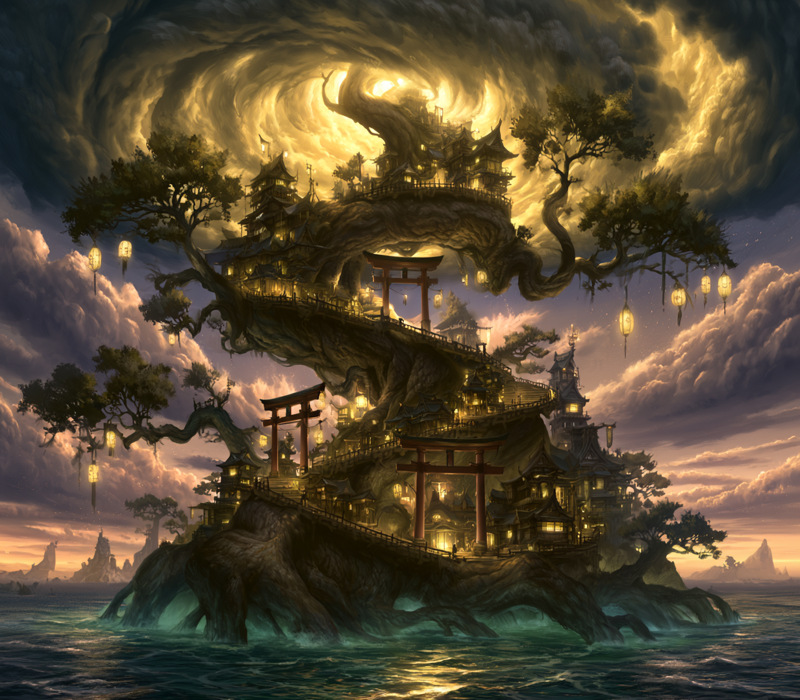
The Second Ring climbs around Yorishiro above the shoreline, built upon broad terraces of dark timber, pale stone, and living branches trained over generations to bear the village’s weight.
It is Hanami’s public face.
Here, the labor of the First Ring becomes something finished. Fish are preserved and sold. Reeds become cloth. Timber becomes boats, furniture, masks, and shrines. Pearls are cut, contracts written, medicines brewed, and stories exchanged over cups of tea.
The First Ring feeds the village.
The Second Ring makes it civilized.
Its streets are narrower than those below but more carefully maintained. Painted screens conceal workshops. Fabric banners hang between upper balconies. Small channels carry rainwater and diluted sap down toward the shore, passing beneath bridges polished smooth by generations of footsteps.
The air smells of cedar shavings, hot iron, roasted tea, damp silk, incense, lacquer, medicinal herbs, and fermented rice.
The sounds of the Second Ring rarely cease:
-
hammers striking iron;
-
handlooms clacking behind paper screens;
-
saws biting through timber;
-
merchants calling prices across the market;
-
tea kettles beginning to sing;
-
ropes tightening beneath heavy loads;
-
rain tapping against tiled roofs;
-
the distant bells of the Third Ring.
Unlike the First Ring, where nearly everyone belongs to the same sprawling web of families and neighbors, the Second Ring receives strangers. Merchants, pilgrims, emissaries, wandering artisans, displaced spirits, and the occasional shipwrecked traveler are housed here until the village decides what to make of them.
Visitors are welcomed.
They are also recorded, observed, discussed, and quietly judged.
First Impressions
The Second Ring begins beyond Shiokaze-no-Mon, the Gate of the Salt Wind.
The change is immediate.
The rough shoreline paths give way to covered stairs and carefully joined walkways. Houses stand two or three stories tall, their upper floors leaning over the streets beneath carved eaves. Workshops open directly onto the public paths, allowing passersby to watch craftsmen at work.
The Ring is crowded without being chaotic.
Goods move uphill.
Orders move downhill.
News moves in every direction.
Small freight platforms rise between terraces on ropes and wooden pulleys. Porters call warnings before loads swing across the walkways. Delivery children weave through crowds carrying lacquered tablets identifying the household, workshop, or shrine awaiting each parcel.
Where the First Ring feels communal, the Second feels interconnected.
Every person belongs to something:
-
a household;
-
a workshop;
-
a guild;
-
an apprenticeship;
-
a commercial association;
-
a longstanding feud;
-
or several of these at once.
Reputation matters here almost as much as it does below.
Coin simply gives reputation something sharper to argue about.
Life in the Second Ring
The day begins slightly later than in the First Ring.
Artisans open their shutters after the first deliveries arrive from the shore. Merchants inspect fresh goods, apprentices sweep storefronts, and clerks carry documents between guild houses and the Civic Stair.
Most families live above or behind their places of work.
Children are expected to assist with simple duties from an early age: sweeping, carrying tea, sorting tools, delivering messages, and listening silently when customers are present. Apprenticeships commonly begin in early adolescence, though particularly talented children may be accepted sooner.
Meals are taken when work allows rather than at fixed hours.
Breakfast is usually eaten standing near the workshop hearth. Midday meals come from market stalls or arrive stacked in small wooden boxes. Evening meals are longer, often shared with employees, apprentices, visiting relatives, or business partners.
The Second Ring values skill above ancestry in principle.
In practice, old workshops guard their reputations fiercely. A newcomer may become wealthy, respected, even indispensable—and still be described as someone who “arrived recently” after forty years.
The Currency of Favors
Coin buys goods.
Favors open doors.
A craftsman may refuse payment but agree to help in exchange for an introduction, a rare material, a promise of future work, or assistance with a personal problem.
These exchanges are rarely written down.
That does not make them informal.
Residents remember who owes whom, who repaid generously, who delayed, and who pretended to forget.
A person who pays every debt in coin is considered dependable.
A person who knows when not to is considered civilized.
Tea and Business
No important agreement begins with numbers.
It begins with tea.
The first cup establishes hospitality.
The second establishes the subject.
Only after the third does serious negotiation begin.
Attempting to discuss price before the first cup is poured suggests desperation, disrespect, or foreign ignorance. Attempting to leave before the second cup suggests that the visitor never intended to bargain honestly.
The Second Ring contains many tea houses, but two dominate its social life:
-
The Cup Beneath the Rain, where rumors become public;
-
The House of Quiet Rain, where arguments become agreements.
Districts of the Second Ring
The Guest Ward
The Guest Ward occupies the terraces immediately beyond Shiokaze-no-Mon.
It contains inns, bathhouses, stables, kitchens, laundries, guides, money changers, and merchants accustomed to dealing with outsiders. Its buildings are brightly marked, its streets well lit, and its residents remarkably good at noticing when a visitor has wandered where they should not.
Foreign guests are expected to remain in the Guest Ward until formally sponsored by a resident or granted broader passage.
This is not imprisonment.
The distinction is explained frequently.
The Bent Bough, Hanami’s largest inn, stands at the center of the ward.
Merchant Square
Merchant Square is neither square nor level.
It follows a wide curve around Yorishiro, broken into stepped platforms connected by short stairs and ramps. Canvas awnings overlap overhead, turning the market into a winding corridor of filtered light, drifting steam, and constant noise.
Nearly anything commonly available in Hanami can be purchased here:
-
preserved food;
-
cloth;
-
rope;
-
lanterns;
-
pottery;
-
household charms;
-
tools;
-
herbal medicines;
-
maps;
-
books;
-
jewelry;
-
storm gear;
-
fishing equipment.
Rare goods are not displayed openly. They are mentioned, hinted at, or shown only after tea.
The Merchant Association maintains an office overlooking the market. Genzaburo is often found beneath its eaves, smiling at someone who has just realized they owe money.
The Craft Houses
The eastern terraces are dominated by workshops belonging to established craft families.
Carpenters, smiths, clothiers, potters, lacquer-workers, rope-makers, paper-makers, mask-carvers, bell-founders, and gem cutters all maintain their homes here.
Many houses display their craft upon the building itself:
-
roof tiles glazed by the resident potter;
-
carved railings from a carpenter’s apprentices;
-
ropes woven into elaborate knots around a doorway;
-
paper lanterns painted with generations of family marks;
-
tiny bells tuned to the voices of a household’s children.
Competition between workshops is intense.
Open hostility is considered embarrassing.
This has merely made the hostility more inventive.
The Bath Quarter
Warm water runs through channels close to Yorishiro’s trunk before emerging in the Bath Quarter.
Public and private bathhouses use this water, each claiming a different medicinal property depending upon the minerals, roots, herbs, or heated stones added to it.
The bathhouses are places of hygiene, recovery, negotiation, gossip, and social equality. Clothing and public rank are left outside, though wealth remains visible through attendants, perfumes, towels, and the quality of one’s soap.
Sango’s bathhouse is the oldest and least fashionable.
It is also the one most residents trust.
The Civic Stair
A broad staircase winds upward from the Second Ring toward Takumi-no-Mon, the Gate of Worthy Hands.
Petitioners, students, shrine servants, officials, couriers, and craftspeople making deliveries to the Third Ring use the stair throughout the day.
Traffic is monitored but rarely stopped.
Benches line the lower landings for those waiting upon appointments. Scribes offer help composing petitions. Vendors sell tea, writing paper, offerings, and more impressive versions of all three to those suddenly worried that their original preparations appear inadequate.
The higher one climbs, the quieter the Ring becomes.
At the top waits Takumi-no-Mon.
Beyond it begins the Ring of Vigil.
Notable Locations
The Bent Bough
The largest inn in Hanami Village is built beneath an enormous living branch that bends outward from Yorishiro before curving back toward the trunk.
The branch forms a natural arch above the roof, sheltering the inn from the heaviest rain.
Inside, the Bent Bough is warm, orderly, and larger than it appears. Guest rooms occupy the upper floors, while the ground level contains a common room, kitchen, private dining chambers, baths, storage rooms, and a reception desk built around a polished knot in the living wood.
Every guest is entered into Kanna’s ledger.
The record includes:
-
name;
-
place of origin;
-
reason for visiting;
-
date of arrival;
-
declared companions;
-
distinguishing possessions;
-
intended duration of stay.
Kanna insists this is for the safety of her guests.
It is.
That is not the only reason.
The Cup Beneath the Rain
Matsuda Ren’s teahouse stands beneath a patchwork roof of overlapping tiles, copper gutters, and stretched silk awnings.
Rainwater falls around the building in thin curtains, giving the impression that the entire teahouse exists behind a veil of water.
Inside, tables are packed closely together. Privacy is technically possible and socially unlikely.
Ren serves roasted barley tea, strong rice wine, fermented plum cordial, and a bitter root infusion reputed to protect against enchantment. Nobody enjoys the latter, which only strengthens its reputation as medicine.
The Cup Beneath the Rain is where the Second Ring hears news from the shore, the upper terraces, and visitors.
A secret told here is not immediately repeated.
It is allowed time to improve.
The House of Quiet Rain
Shizuku-an
The House of Quiet Rain stands apart from the market roads behind a simple grey wall.
Its garden contains raked gravel, moss-covered stones, dwarf pines, and a single narrow channel through which rainwater runs beneath the tea room.
Madam Tsuyu has served tea here for nearly sixty years.
The house observes four rules:
-
No raised voices.
-
Shoes remain outside.
-
Nobody sits until everyone has arrived.
-
Tea is poured from the eldest guest to the youngest.
People do not come to Shizuku-an for food.
They come because arguments somehow become conversations before the second cup.
Guild disputes, marriage negotiations, questions of apprenticeship, compensation for damages, and delicate political conversations often take place here.
Madam Tsuyu claims no responsibility for the outcomes.
She merely chooses the tea.
The Seven-Ink Studio
Shiori’s workshop is crowded with drying papers, brushes, carved seals, silk scrolls, inkstones, and jars containing colors no one else in Hanami knows how to reproduce.
Each of Shiori’s seven tails bears a different color at its tip.
She uses them as brushes when working quickly.
The studio produces:
-
legal contracts;
-
family records;
-
formal invitations;
-
petitions to the Third Ring;
-
protective talismans;
-
copied sutras;
-
maps;
-
ceremonial calligraphy.
Among Shiori’s papers are fragments of an old derro mining register purchased decades ago as scrap.
Most of it concerns quotas, work assignments, ventilation shafts, and collapses.
One surviving line reads:
The clear heart sleeps beneath the western root.
Shiori has never discovered whether this refers to a diamond, a chamber, a machine, or something alive.
Hachiro’s Yard
Takumi Hachiro’s structural yard occupies a broad platform crowded with timber, pulleys, scaffolding, replacement beams, carved braces, and architectural models.
The walls are covered in diagrams showing the movement of Yorishiro’s branches throughout the seasons.
Hachiro treats every structure in Hanami as temporary.
Not because it is poorly made.
Because the tree is alive.
Stairs must be adjusted. Supports must be moved. Walls must yield. Buildings that refuse to change are eventually broken by growth.
Hachiro possesses old surveys showing a maintenance shaft descending from the Second Ring toward the submerged foundations.
The shaft was sealed many years ago.
The official reason was instability.
Hachiro does not believe the official reason.
Dokue’s Apothecary
Dokue’s shop is narrow, dark, and crowded with dried plants, bottled insects, preserved organs, mineral salts, fungal cultures, and softly chiming glass vessels.
Labels are written in several languages and arranged according to a system Dokue refuses to explain.
The shop treats:
-
venom;
-
drowning injuries;
-
pressure sickness;
-
fungal infection;
-
magical contamination;
-
spirit possession;
-
hangovers;
-
imagined illnesses;
-
real illnesses worsened by being imagined.
Dokue once treated a survivor from the derro mines.
The patient’s blood contained powdered crystal and traces of an unfamiliar paralytic toxin. The patient survived.
Dokue does not say for how long.
Gen’s Cutting Room
Kohaku Gen’s workshop is almost unnaturally clean.
Every tool has a place. Every stone is wrapped, labeled, and stored according to hardness, origin, clarity, and magical behavior.
Gen works with jade, coral, pearls, volcanic glass, root-crystal, and the tiny diamonds occasionally recovered from derro artifacts.
He confirms that resurrection magic requires more than monetary value.
The stone must be:
-
large enough;
-
structurally sound;
-
free of magical corruption;
-
capable of being consumed completely by the spell.
A flawed diamond may merely fail.
A contaminated one may answer the magic incorrectly.
“Value is what merchants see. Purity is what magic sees.”
The Twin Knot
Chiyo and Chiharu’s rope workshop hangs beneath one of the Second Ring’s outer platforms.
Ropes descend from the rafters in hundreds of coils: silk cords, climbing ropes, fishing lines, ceremonial knots, weighted diving lines, rescue harnesses, and enchanted bindings.
Nobody is entirely certain which twin is Chiyo.
Asking does not help.
Their ropes incorporate strands of enchanted hair and respond to purpose. A knot tied by one sister can be undone only by the other—or by speaking aloud the reason for which it was tied.
The twins claim their grandmother traded with the derro before the valley was displaced.
Their accounts contradict one another on almost every detail.
They agree on one thing:
“The derro did not abandon the deepest mine.”
“No. The deepest mine abandoned them.”
They then argue over which phrasing is correct.
Sango’s Bathhouse
Sango’s bathhouse is built around an old channel carrying warm water from deep within Yorishiro’s root system.
Its floors are scrubbed white. Its rules are painted in large characters above the entrance. Its attendants enforce them without mercy.
Guests must wash before entering the baths.
Sango considers failure to do so a moral defect.
Through submerged maintenance tunnels beneath the bathhouse, she has discovered that seawater periodically drains into chambers below the village before surging outward again.
For several minutes during this reversal, one route toward the derro mines becomes considerably safer.
Sango knows when.
She will share the information if convinced that the party is competent enough not to drown and foolish enough to go regardless.
The Bell Archive
The Bell Archive occupies a narrow, cool building near the upper edge of the Second Ring.
Fuyumi maintains civic records, trade agreements, family registries, historical accounts, storm observations, and copies of old bell patterns used throughout Hanami.
Shelves line every wall.
Bronze chimes hang between them, each tuned to a different archive section. Fuyumi can locate a document by striking the correct sequence and listening for sympathetic vibration.
Among the archive’s oldest possessions is a map created before the valley was displaced between planes.
It shows Jinja no Oka as it once stood.
The derro mine entrance appears upon the hill’s western slope.
That entrance now lies hundreds of feet beneath Gai Umi.
A second entrance is marked beneath a shrine no longer present on any modern map.
The Bark House
Kaede no Tsuyu’s home was not built against Yorishiro.
It grew from it.
The narrow dwelling emerges directly from a fold in the bark, its walls patterned like wood grain and its windows sealed by translucent amber sap.
Kaede listens to Yorishiro through the floor, walls, and exposed trunk. She interprets shifts in sap, tension, vibration, and warmth.
She is not a priestess.
She corrects anyone who calls her one.
Kaede believes that something in or beneath the derro mines is irritating one of Yorishiro’s deepest roots.
At certain hours the root grows agitated.
At others it becomes still enough for passage.
Kaede refers privately to the god-tree as Jinraikoku:
The realm where divine thunder takes root.
She refuses to explain whether this is a title, a translation, or a name the tree gave her.
People of the Second Ring
Umejiro Kanna
Female human
Innkeeper and proprietor of the Bent Bough
“A guest may keep secrets. Mud is under no such obligation.”
Kanna is warm, generous, and nearly impossible to deceive.
She does not question guests directly. She notices what they order, which companions they avoid, whether they sleep, and what clings to their shoes.
She knows that several expeditions have attempted to reach the derro mines.
Most returned without diamonds.
Some did not return.
Kanna offers the party rooms once their guest-cords are recognized. Faelen’s body may be placed in a cool private chamber if Benda’s shop or the Shoreline Shrine is unsuitable.
Her hospitality is sincere.
So is her interest in knowing exactly what has entered her house.
Takumi Hachiro
Male hobgoblin
Carpenter and structural warden
“Wood bends. Stone settles. Adventurers fall through railings.”
Hachiro oversees the platforms, bridges, supports, stairs, and buildings of the Second Ring.
No nail may pierce Yorishiro’s living bark without his permission.
He is gruff, overworked, and prejudiced against adventurers on practical rather than moral grounds. In his experience, they climb supports, ignore warning signs, cut useful ropes, and assume locked passages contain treasure rather than structural collapse.
Hachiro possesses a survey showing a sealed maintenance shaft leading downward toward the submerged foundations.
He will not provide it merely because someone is in a hurry.
He might provide it to someone who demonstrates that they understand the difference between courage and carelessness.
Shiori of the Seven Inks
Female kitsune
Scribe, contract-maker, and talisman painter
“Ink is only permanent when people fear what it records.”
Shiori is elegant, curious, and fond of bargains in which money is the least interesting part.
She copies texts, writes contracts, prepares formal petitions, and creates protective talismans.
She recognizes immediately that the adventurers did not arrive through an ordinary shipwreck. Their guest-cords tell one story. The planar residue upon them tells another.
Shiori possesses fragments of the derro mining register.
She will not sell them.
She may trade them for:
-
a story never before written;
-
a rare pigment;
-
a promise of first access to anything inscribed within the mines;
-
help with a matter she cannot place in an official petition.
Matsuda Ren
Male tanuki
Brewer and proprietor of the Cup Beneath the Rain
“A secret is only a story that has not yet found enough cups.”
Ren is jovial, round-bellied, and fascinated by other people’s misfortune.
He is rarely cruel about it.
He simply believes every disaster improves in the retelling.
Ren knows that:
-
Benda possesses the resurrection scroll;
-
Josei entered a storm no sensible fisher would challenge;
-
someone recently purchased diving equipment and never returned it;
-
faint hammering can sometimes be heard beneath the sea at low tide;
-
Genzaburo believes diamonds have already been smuggled from the mines.
Information given to Ren becomes public sooner or later.
Usually in a more entertaining form.
Ayame Kurogasa
Female tengu
Clothier and mask-maker
“A good garment tells the weather it has arrived too late.”
Ayame creates storm cloaks, formal robes, ritual masks, waterproof garments, diving suits, and protective wrappings.
She is distantly related to Rojin and openly believes that the Elderman is too cautious. In her view, the upper Rings praise the First Ring’s humility whenever they want it to accept less.
Ayame can prepare enchanted diving garments for the expedition.
She requires silk from water-spiders nesting beneath one of the outer docks, a material difficult to gather without destroying the colony.
Her masks can also shield a wearer’s emotions from certain spirits.
Ayame does not recommend wearing one while negotiating with a person.
She does recommend it anyway.
Dokue
Nonbinary green oniborn
Apothecary
“You are not dying. Stop wasting the expression.”
Dokue possesses excellent medical skill and a bedside manner best described as punitive.
They treat poison, disease, drowning, magical contamination, and injuries caused by poor judgment.
For the mine expedition, Dokue can prepare:
-
water-breathing draughts;
-
antitoxin;
-
salves against pressure and cold;
-
fungal treatments;
-
stimulants effective against derro paralytic poison.
Dokue prefers payment in ingredients.
Coin is accepted only when it has become clear that the customer owns nothing more useful.
Kohaku Gen
Male earth genasi
Gem cutter
“Every stone tells the truth. Most people dislike the answer.”
Gen is the village’s leading authority on gems.
He is patient with stone and impatient with everyone else.
Gen can confirm whether a recovered diamond will satisfy the resurrection spell. He can also identify magical contamination, unnatural growth, and signs that a stone formed under planar rather than ordinary geological pressure.
He refuses to enter the derro mines.
When asked why, he answers:
“I know enough about stones to understand when one should remain where it grew.”
Chiyo and Chiharu
Elderly female korred twins
Rope-makers
“Never trust a knot tied by one hand.”
The twins quarrel continuously and work in complete harmony.
Their ropes are prized throughout Hanami, particularly by fishers, climbers, builders, and storm-watchers.
They can provide the party with enchanted underwater ropes, rescue harnesses, and lines that tighten when their bearer loses consciousness.
The twins expect a story upon the party’s return.
Not payment.
They possess enough payment.
They lack a satisfying ending to their grandmother’s account of the derro.
Sango
Female kappa
Bathhouse keeper
“Wash first. Drown afterward.”
Sango is stern, practical, and wholly unimpressed by Nagi.
She maintains the oldest bathhouse in the Second Ring and knows the water channels beneath the village better than almost anyone.
She can identify the safest window for approaching the mines, when the current reverses and seawater drains inward.
Sango insists that Nagi’s knowledge is unreliable.
Nagi insists that Sango’s knowledge is boring.
Both are useful.
Neither enjoys hearing this.
Fuyumi
Female snowborn elf
Keeper of the Bell Archive
“History does not repeat. People simply refuse to read it.”
Fuyumi arrived in Hanami decades ago and has never explained where she came from.
She maintains the Ring’s civic and historical records and has spent years comparing storm reports with ceremonial bell patterns.
Fuyumi suspects Raiko is not merely an effect of the old binding.
It may be part of the mechanism that sustains it.
Her pre-displacement map provides the most accurate surviving record of the derro mine’s original entrances.
She will permit the party to copy it.
She will not permit them to take the original.
Genzaburo
Male redcap
Market constable and debt collector
“Failure to declare treasure does not make it less taxable.”
Genzaburo is impeccably polite, beautifully dressed, and terrifyingly efficient.
He enforces market rules, settles commercial disputes, collects debts, and confiscates undeclared goods.
Unlike many of his kind, he has redirected violent instincts into bureaucracy.
Mostly.
Genzaburo believes someone has already recovered diamonds from the derro mines and concealed them to manipulate prices.
He may investigate the adventurers, attempt to register their expedition, demand an inventory of anything recovered, or insist that a market observer accompany them.
He is not corrupt.
This frequently makes him more difficult.
Kaede no Tsuyu
Female dryad
Interpreter of Yorishiro
“The tree does not speak. Speaking is what people do when they have stopped listening.”
Kaede is quiet, strange, and impatient with religious assumptions.
She does not worship Yorishiro.
She listens.
Kaede can tell when the submerged roots are calm enough to approach and when movement within the mines is likely to provoke a reaction from the tree.
She believes the expedition will find more than derro ruins.
Something below is pressing against a root that should not be able to feel pain.
Emi
Human child, approximately nine years old
Sweeper of streets and finder of shortcuts
“Everyone knows Emi. Nobody knows who sent her.”
Emi is always carrying a broom.
She sweeps leaves from walkways, workshop thresholds, shrine steps, and bridges regardless of whether anyone asked her to.
Everyone assumes she belongs to another household.
No one can clearly name which one.
Emi knows:
-
every cat in the Second Ring;
-
every shortcut;
-
every roof that can safely be crossed;
-
every hidden shrine;
-
which doors are never locked;
-
where adults go when they do not want children listening.
If treated kindly, she will guide the party almost anywhere.
She refuses to climb one narrow staircase toward the Third Ring.
When asked why, she says:
“Grandfather says those steps are only for people the tree has already met.”
She will not identify Grandfather.
Madam Tsuyu
Elderly human woman
Mistress of the House of Quiet Rain
“Drink first. Decide afterward.”
Madam Tsuyu has served tea for nearly sixty years.
Her movements are slow, exact, and impossible to interrupt.
She does not arbitrate disputes.
She creates the conditions in which people become embarrassed to continue behaving badly.
Madam Tsuyu knows the history of nearly every feud in the Second Ring. She also knows which apparent feuds conceal friendships, debts, romances, and alliances.
Lady Fa Q has taken tea with her.
Once.
Neither woman has spoken publicly about what was discussed.
Takumi-no-Mon
The Gate of Worthy Hands
The Second Ring ends at a smaller, more ornate vermilion gate standing before the ascent into the Third Ring.
Hundreds of miniature tools are carved into its pillars:
-
needles;
-
hammers;
-
brushes;
-
ladles;
-
chisels;
-
knives;
-
looms;
-
bells;
-
keys;
-
instruments whose purpose has been forgotten.
Its paint is renewed each year by the artisans of the Second Ring. No single workshop may complete the task alone.
Every guild, family, and independent craftsperson must contribute.
Takumi-no-Mon marks the transition from livelihood to service.
Residents of the lower Rings may pass for religious observance, education, official petitions, formal ceremonies, shrine service, or work commissioned by the Third Ring.
Foreign visitors require sponsorship, invitation, or an official guest seal.
The gate is overseen by the Two Measures:
Hinode Mai, a crane-folk registrar, records the purpose of each ascent.
Iwao Ban, a stoneborn appraiser, determines whether the traveler is properly prepared.
Mai measures intention.
Ban measures readiness.
Their customary question is:
“What work carries you upward?”
A traveler is expected to carry something representing their purpose: a tool, petition, book, offering, gift, ceremonial garment, flower, or stone.
Passing empty-handed suggests an intention to take without contributing.
When someone passes honestly, the carved tool matching their purpose grows faintly warm.
When someone enters under false pretenses, every carving remains cold.
Factions of the Second Ring
The Merchant Association
The Merchant Association regulates stalls, imports, prices, weights, contracts, and access to scarce goods.
It claims to protect customers from exploitation and merchants from ruinous competition.
Both statements are true.
It is dominated by prosperous families who believe their success demonstrates sound judgment. Benda technically belongs to the Association but is not greatly respected by its wealthier members, who consider his willingness to give away valuable goods financially irresponsible.
Genzaburo enforces the Association’s rulings.
The Craft Houses
The Craft Houses are old workshop families whose identities are inseparable from their trades.
They care deeply about:
-
apprenticeship;
-
lineage of technique;
-
quality;
-
reputation;
-
proper credit;
-
who taught whom;
-
who copied whom;
-
who claims not to have copied anyone.
Craft Houses compete for commissions from the Third Ring and frequently resent independent artisans who achieve success without belonging to an established lineage.
Hachiro, Ayame, Shiori, Gen, and the korred twins all possess influence among different houses, though none fully control them.
The Guest Ward
The Guest Ward represents Hanami to outsiders.
Its innkeepers, guides, bathhouse attendants, porters, translators, and merchants are expected to remain welcoming even when suspicious.
Their hospitality is not false.
It is professional.
Kanna is the Ward’s unofficial leader. Ren is its loudest voice. Madam Tsuyu is the person everyone consults after the loud voices have failed.
The Civic Stair
The clerks, petition writers, messengers, registrars, and attendants of the Civic Stair form an informal faction of their own.
They control no goods and command no soldiers.
They do, however, know:
-
whose petition is delayed;
-
whose invitation was withdrawn;
-
which Third Ring household is buying unusual supplies;
-
which craftspeople are quietly favored by Lady Fa Q’s administration;
-
which official explanations do not match the documents.
They are overlooked constantly.
They find this useful.
The Second Ring and the Resurrection Quest
The Second Ring turns the search for a diamond into an expedition.
No single resident possesses everything the party requires. To prepare properly, the adventurers must gather knowledge, equipment, and trust from several sources.
They may seek:
-
Hachiro’s survey of the sealed maintenance shaft;
-
Shiori’s mining register and its reference to the western root;
-
Ayame’s diving garments;
-
Dokue’s antitoxin and pressure salves;
-
Gen’s criteria for identifying a viable diamond;
-
the twins’ enchanted rope;
-
Sango’s current-reversal timetable;
-
Fuyumi’s pre-displacement map;
-
Kaede’s reading of Yorishiro’s submerged roots;
-
Ren’s rumors about earlier expeditions;
-
Kanna’s guest records, which may identify those who never returned.
The party does not need every advantage.
Time is limited.
Choosing which leads to pursue should shape the mine expedition:
-
Without Hachiro, they may approach through the exposed underwater entrance.
-
Without Sango, they may fight the full strength of the current.
-
Without Ayame or Saburo’s magic, underwater travel becomes more dangerous.
-
Without Dokue, derro poison is far more threatening.
-
Without Fuyumi, navigation through the old tunnels becomes uncertain.
-
Without Kaede, the party may mistake Yorishiro’s movement for structural collapse.
-
Without Gen, they may return with the wrong stone.
-
Without Shiori, they may never learn that the “clear heart” lies beneath the western root.
Every preparation consumes time.
Every shortcut increases danger.
Suggested Second Ring Encounters
A Broken Support
One of the lower market platforms shifts after a tremor passes through Yorishiro.
Hachiro orders the area cleared and needs immediate help stabilizing the structure. Adventurers who assist intelligently earn his respect and access to the old maintenance survey.
Adventurers who simply display strength may save lives but confirm all his worst opinions about them.
Silk Beneath the Docks
Ayame needs water-spider silk to complete the diving garments.
The colony nests beneath a flooded support platform. The spiders are not hostile unless their egg sacs are disturbed.
The challenge is gathering silk without damaging the colony—or provoking Nagi, who has named several of the spiders.
The Missing Guest
Kanna’s ledger reveals that a previous visitor purchased diving equipment, asked about the western root, and vanished.
The visitor’s room was emptied.
One object remains concealed beneath a floorboard: a derro token, a partial map, or a note warning that the hammering below the sea is not caused by tools.
Undeclared Stones
Genzaburo detains a merchant carrying tiny unregistered diamonds.
The merchant insists they are old family possessions.
Gen determines they were cut recently.
The stones may prove that someone has already entered the mines—or that something beneath the village has begun sending diamonds upward.
The Silent Bell
A bell in Fuyumi’s archive rings in sympathy with no visible source.
The sound corresponds to a sealed record associated with the original binding of Yorishiro.
At the same moment, Kaede feels one of the submerged roots tense.
The party may have only minutes before the safest descent window changes.
Rumors in the Second Ring
Characters gathering information may hear the following:
-
“The diamonds grew where Yorishiro’s roots crushed the bones of the earth.”
-
“The derro were not miners. They were surgeons.”
-
“A maintenance stair still descends from Hachiro’s yard.”
-
“There is no stair. Hachiro invented it to frighten apprentices.”
-
“Sango can tell when the sea breathes inward.”
-
“Someone has been selling derro-cut stones in secret.”
-
“The deepest tunnels are dry.”
-
“The deepest tunnels are not underwater because they are not beneath the sea anymore.”
-
“The hammering stops whenever the storm bells ring.”
-
“The clear heart is not a diamond.”
-
“Kaede heard the tree cry out three nights ago.”
-
“Emi has been seen sweeping a stair that does not exist during daylight.”
Not all of these rumors are true.
Several may be true in ways no speaker understands.
Running the Second Ring
The Second Ring should feel busy, generous, and mildly exhausting.
Everyone can help.
Nearly everyone wants something first.
That need not mean a formal side quest. A favor might be a conversation, an introduction, a promise, a brief act of service, or proof that the party understands what is at stake.
The Ring should also complicate the village’s apparent harmony.
The people of Hanami care for one another, but they disagree about:
-
wealth;
-
status;
-
responsibility;
-
the authority of the Third Ring;
-
how much danger should be accepted for outsiders;
-
whether the derro mines should remain sealed;
-
whether Lady Fa Q’s administration protects the village or increasingly controls it.
Keep the resurrection deadline visible.
Let Benda’s warnings arrive through messengers.
Let the party see supplies being prepared for them while merchants argue over payment.
Let craftspeople work through the night because a dead stranger still has a chance to live.
The players should leave the Second Ring with more than equipment.
They should understand that Hanami Village is not held together by perfect agreement.
It is held together by thousands of people continuing to do their work despite disagreement.
And beneath them, among the roots, something has begun doing its work again.





I really enjoyed how vividly Hanami Village is brought to life the rich atmosphere and detailed worldbuilding make it feel like a place with its own history and soul. What inspired you to create Hanami Village's culture and lore and are there any hidden stories or mysteries you plan to reveal later?