The First Ring
The Ring of Salt
The people who feed the village.
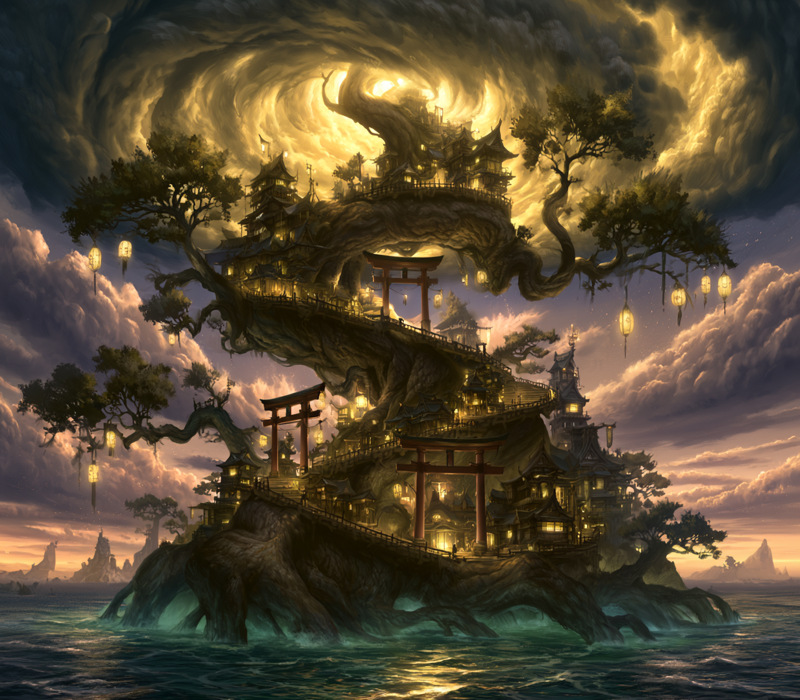
The First Ring is the lowest and broadest of Hanami Village’s three inhabited tiers. It spreads along the island’s sloping shoreline and gathers closely around the immense base of Yorishiro, where the god-tree’s bark disappears into earth, black stone, and seawater.
Here live the fishers, farmers, pearl divers, boatwrights, grocers, net-menders, shrine attendants, and laborers upon whom the rest of the village depends. The First Ring possesses little of the refinement of the terraces above, but neither is it poor. Its houses are carefully repaired, its nets brightly mended, and its narrow walkways swept clean every morning.
Rice steams from open windows. Fish dry beneath painted awnings. Children chase dragonflies between rain barrels and stacked crab pots. Shell wind chimes turn beneath the eaves, making soft music whenever the sea breeze reaches inland.
Everyone knows everyone.
More dangerously, everyone knows everyone else’s business.
Fifty to a hundred families have lived here around the sacred tree for generations. Reputation carries greater weight than coin, and no deed remains private for long. A newcomer may be welcomed warmly, but they will also be watched, discussed, and quietly measured against the customs of the Ring.
The First Ring feeds Hanami Village.
It also remembers who helped when the nets came back empty.
First Impressions
The air smells of salt, wet cedar, charcoal smoke, seaweed, and cooking rice.
The sounds of the First Ring begin before sunrise:
-
waves breaking against the roots;
-
boats knocking against the docks;
-
gulls crying over the fish market;
-
neighbors calling to one another across narrow bridges;
-
children running where they have been repeatedly told not to run;
-
shell chimes trembling beneath the distant thunder.
Rain falls frequently, carried inward from Raiko, the storm that circles the island. It darkens the roofs and washes the wooden paths clean, yet the paper lanterns strung between houses never go out.
Beyond the shore lies Gai Umi, the Outside Sea. The villagers speak its name as one might speak of a temperamental neighbor: with affection, caution, and the assumption that it is listening.
Above everything rises Yorishiro.
From the First Ring, the god-tree is less a tree than a landscape. Its trunk forms walls, overhangs, crevices, and sheltered courts. Some homes stand beside it. Others are built directly against its bark, though no nail is permitted to pierce the living wood.
Far above, the higher Rings disappear into mist.
Life in the Ring
Life follows the rhythm of water, weather, and daylight.
Fishers leave while the sky is still dark, as long as the Storm Bells are not rung. Farmers tend narrow terraces wherever soil has gathered between Yorishiro’s roots. Grocers open their shutters after the first boats return, and children carry baskets, messages, and gossip along the waterfront.
Breakfast is usually simple:
-
rice;
-
grilled fish;
-
pickled vegetables;
-
miso or seaweed broth;
-
hot tea.
Doors are rarely locked. Privacy is respected in principle and defeated in practice by thin walls, shared walkways, and attentive neighbors.
Arguments happen loudly but seldom endure. It is considered shameful to let a grievance survive the evening meal. Those unable to reconcile are expected to take tea together under the supervision of a mutually respected elder.
Work is communal when necessary. Storm damage, sick relatives, failed catches, and broken boats are treated as village problems before they become private disasters.
The people of the First Ring do not consider themselves lowly.
They consider themselves necessary.
Customs of the First Ring
Tea After Labor
Tea in the First Ring is intimate rather than ceremonial. It is shared after work, offered to neighbors, and poured for anyone delivering difficult news.
Refusing the first cup may be polite.
Refusing the second means refusing the relationship being offered.
The Daily Flower
Each dawn, exactly one new flower blooms somewhere upon Yorishiro.
No one knows where it will appear.
Children race through the lower paths looking for it, peering beneath stairs, behind rain barrels, and into hollows in the bark. Whoever finds it first is said to enjoy unusual good fortune until sunset.
Adults insist this is a children’s superstition.
Adults also become strangely competitive whenever they notice the flower first.
Returning from the Sea
Those returning from a dangerous voyage touch the left pillar of Shiokaze-no-Mon before going home.
Those departing on one touch the right.
A voyager who touches both pillars fears not to return.
Local Manners
In the First Ring, one should never:
-
mock another person’s boat;
-
step over a fishing net;
-
whistle toward the sea after sunset;
-
count another family’s catch aloud;
-
point toward Raiko;
-
interrupt someone repairing a shrine charm;
-
ask why an empty place has been left at a table — one additional plate is always set for Yorishiro.
Notable Locations
The Saltwater Docks
The docks form the practical heart of the First Ring.
Fishing boats, narrow ferries, diving skiffs, and reed-sided barges crowd together beneath patched awnings. Ropes are tied not only to posts, but around smaller exposed roots of Yorishiro, using padded loops designed not to damage the bark.
The docks are rarely quiet.
Fish are unloaded here before dawn. Children search abandoned baskets for crabs. Boatwrights argue over timber. Storm-watchers occasionally descend from the Third Ring to inspect changes in the tide.
Josei Ryoshi keeps her boat at the outermost pier.
Most fishers consider the berth cursed.
Josei considers it convenient.
Josei’s Pier
Josei’s narrow pier extends farther into Gai Umi than any other structure in the First Ring.
Its wood is bleached almost white, and wind chimes made from golden fish scales hang beneath the railing. During ordinary weather they make no sound. When Raiko shifts, they begin to ring.
Josei’s boat is small, battered, and improbably seaworthy.
The villagers insist it has survived conditions that should have broken vessels three times its size. Josei merely says that a boat knows whether its owner intends to return.
When the party arrives in the sea, it is Josei who dares to cross into the storm and rescue them.
Rain does not strike her face.
Fish leap beside her hull.
Seabirds follow where no seabird should be able to fly.
The waves flatten just enough to let her pass.
To the people of the First Ring, this is simply Josei being Josei.
Akemi Provisions
Benda Akemi’s grocery is marked by strings of dried red peppers and a painted wooden turnip hanging above the door.
The shop is much larger inside than its narrow frontage suggests. Its shelves hold rice, tea, pickled vegetables, lamp oil, rope, candles, preserved fish, medicinal spirits, paper, ink, kitchenware, and an astonishing collection of objects that Benda claims someone will eventually need.
He is usually correct.
Hidden among his stock is a precious scroll capable of casting raise dead.
Benda does not display it, advertise it, or treat it as merchandise. The scroll is an emergency safeguard entrusted to his family and meant to preserve a life when no other recourse remains.
When Faelen is brought ashore, Benda is willing to use it.
The problem is its material requirement: a diamond of sufficient quality worth at least five hundred gold pieces.
No such stone exists openly in Hanami Village.
Benda’s sister Hoshino knows where one might be found.
Hoshino’s Cutting Table
Hoshino Akemi works from a small open-fronted shop adjoining her brother’s grocery.
She cuts pearls, coral, jade, volcanic glass, and the unusual crystals that sometimes wash ashore after violent storms. Her worktable sits beneath a broad window where natural light falls across rows of tiny tools.
Hoshino has never handled a diamond large and pure enough for Benda’s spell.
She has, however, seen small diamonds recovered from objects associated with the old derro mines beneath the sea.
When told what the party needs, she is quiet for a long time.
Then she says:
“That belongs beneath the roots.”
Hanae’s Tea House
Hanae’s tea house has no formal name.
Everyone simply calls it Hanae’s.
It stands near the center of the First Ring, where three walkways meet beneath an old leaning lantern post. The room is warm, crowded, and perpetually fragrant with roasted tea, rice cakes, and whatever stew Hanae prepared that morning.
Everyone tells Hanae everything.
She never asks questions.
She pours tea, listens, and occasionally slides a fresh cup toward whichever person has not yet admitted what they came to say.
By evening she knows which boats returned late, whose child skipped lessons, who argued with whom, and what strangers were seen climbing toward the Second Ring.
Hanae is the social heart of the First Ring.
Secrets do not necessarily leave her tea house.
They simply cease to belong entirely to the person who brought them in.
The Shoreline Shrine
A modest shrine stands where Yorishiro’s broadest root enters Gai Umi.
Its roof is weighted with smooth black stones, and its entrance is hung with white paper streamers that remain dry even in heavy rain. Offerings of rice, tea, salt, flowers, and the first fish of a successful catch are placed before a shallow hollow in the bark.
Brother Kenta tends the shrine.
He does not believe Yorishiro requires food.
He believes people require gratitude.
Each morning he cleans away spoiled offerings, replaces damaged charms, and listens to the concerns of villagers who claim they came only to pray.
The Pearl Steps
A long stone stair descends from the shoreline into clear water.
Pearl divers once gathered here before expeditions, checking one another’s ropes and breathing charms. Most diving now takes place farther from the island, but the steps remain a meeting place for fishers, swimmers, and adventurous children.
Saburo spends many afternoons sitting near the upper landing.
From there he can identify almost every current by the shape it leaves on the surface.
He can also see the waters above the derro mines.
He never looks in that direction for long.
The Vegetable Terraces
Small gardens occupy every patch of soil that has gathered between Yorishiro’s roots.
Farmers grow radishes, cucumbers, onions, herbs, tea shrubs, beans, and dwarf rice in narrow flooded beds. Rainwater is directed through wooden channels, while rich silt gathered from the shoreline is carried uphill by hand.
Nagi is frequently found here stealing cucumbers.
Her argument is that a cucumber taken directly from the vine cannot yet legally belong to anyone.
This interpretation has not gained widespread acceptance.
Shiokaze-no-Mon
The Gate of the Salt Wind
The largest of Hanami’s three vermilion gates stands where the First Ring rises toward the Second.
Its pillars are weathered and salt-bleached. Nets, shells, carved floats, broken oars, and small wooden fish hang from its crossbeam.
Shiokaze-no-Mon is rarely closed.
It marks the boundary between the working shoreline and the more prosperous terraces of trade and craft above.
Residents may pass freely.
Visitors must first be formally received, give their name and place of origin, wash away seawater or road dust, and receive a guest-cord of white reed and blue thread.
The cord places them under the village’s protection.
It also places them under its laws.
Namihei Moku, the elderly mujina who keeps the gate, asks each stranger:
“What has the water carried to us?”
When Josei brings the party to the Second Ring, she leads them through without waiting for permission.
Moku does not stop her.
He ties a guest-cord around each adventurer’s wrist and says:
“The water has answered for you. Try not to make it regret the introduction.”
People of the First Ring
Josei Ryoshi
Female gold koi nikishin tatsumi
Fisherwoman
“If Josei says the sea is angry, stay ashore.”
Josei Ryoshi is broad-shouldered, weathered, and far more comfortable aboard a boat than inside a house. She wears layered fishing robes patched so often that little of the original cloth remains visible.
She speaks plainly and dislikes ceremony.
Josei is the only fisher willing to enter Raiko when the adventurers appear in the sea. She sails into the storm without waiting for permission, debate, or assistance.
She has an unusual connection to the surrounding waters:
-
rain refuses to strike her face;
-
fish leap alongside her boat;
-
seabirds follow her into the storm;
-
waves flatten just enough for her to pass.
Josei considers these occurrences ordinary and becomes irritated when others treat them as miraculous.
If persuaded to take up a greater role in the coming conflict, she may awaken fully as a ryujin tatsumi.
Josei does not believe herself destined for anything.
She believes there is work that must be done and that discussing destiny wastes daylight.
Benda Akemi
Male red oniborn
Grocer and keeper of the resurrection scroll
“If Benda does not have it, you did not need it.”
Benda is large, red-skinned, soft-spoken, and habitually dusted with flour or spice.
He knows the contents of every shelf in his store but maintains no visible system of organization. When asked for an obscure object, he disappears into the back room and returns carrying it as though it had been waiting for that exact request.
Benda possesses a scroll of raise dead, inherited with the responsibility to use it only when a death is sudden, unjust, and still close enough to reverse.
Faelen’s death qualifies.
Benda will not ask the adventurers for payment for the scroll.
He will, however, insist that they supply the required diamond.
He knows that the spell offers a possibility, not a promise, and refuses to let desperation turn that distinction into false hope.
Rojin
Male tengu
Elderman of the First Ring
“Ask Rojin once. He already heard you.”
Rojin is old, narrow, and perpetually wrapped in a dark rain cloak. The hair along his face and hands has gone silver with age.
He is the recognized spokesman of the First Ring, though Lady Fa Q remains the ultimate authority over Hanami Village.
Rojin settles disputes, organizes communal labor, speaks for fishing families before the upper Rings, and ensures that no household quietly goes hungry.
He is patient with mistakes and merciless toward selfishness.
Rojin immediately understands the danger of allowing outsiders to descend among Yorishiro’s submerged roots. He will not forbid the party from seeking the diamond, but neither will he permit them to treat the derro mines as an abandoned treasure vault.
“Everything beneath the roots belongs to someone.”
When asked who, he changes the subject.
Hoshino Akemi
Female oniborn
Lapidary and coral cutter
Hoshino is Benda’s younger sister and possesses none of his patience.
She is direct, meticulous, and deeply offended by careless use of words such as gem, jewel, and crystal as though they were interchangeable.
She has never seen a diamond large enough for the resurrection spell. Tiny stones of remarkable purity have, however, appeared in old derro tools and ornaments recovered from beneath the sea.
Hoshino can identify a suitable diamond and distinguish natural flaws from dangerous magical contamination.
She cannot teach the party how to find one.
For that, they will need Saburo, Nagi, and eventually the specialists of the Second Ring.
Hanae
Female kitsune
Tea-house keeper
“Tea reaches Hanae before gossip does.”
Hanae appears serene even when her tea house is overflowing.
Her russet tails move constantly behind her, retrieving cups, sweeping crumbs, nudging stools into place, and occasionally tripping customers who have become too loud.
She knows virtually everything that happens in the First Ring.
Hanae can tell the party:
-
who last spoke openly about the derro mines;
-
which villagers have lost relatives beneath the water;
-
why Saburo stopped diving;
-
that Nagi knows more entrances than she admits;
-
which people might help without informing the upper Rings.
She will not simply hand over this knowledge.
First, she needs to understand what sort of people the adventurers are.
Fortunately, there is tea for that.
Nagi
Female kappa
Guide, nuisance, and cucumber thief
“If Nagi is quiet, check the roofs.”
Nagi is small, green-skinned, quick, and incapable of respecting a boundary that has not been physically reinforced.
Children adore her.
Adults tolerate her because she retrieves lost fishing gear, rescues swimmers, clears blocked water channels, and knows every underwater opening around the island.
She constantly steals cucumbers from the vegetable terraces.
Nagi knows more than one entrance into the derro mines.
She refuses to approach one particular stretch of water where the current descends between two enormous black roots.
When questioned, she jokes, changes the subject, or pretends to have forgotten the language being spoken.
Fear is one of the few emotions she cannot conceal well.
Brother Kenta
Male human
Caretaker of the Shoreline Shrine
“Gratitude feeds people better than offerings feed trees.”
Kenta is a quiet middle-aged man whose plain robes always smell faintly of rain and incense.
He performs the daily offerings to Yorishiro, blesses fishing boats, comforts grieving families, and mediates minor disagreements before they reach Rojin.
Kenta does not believe the offerings sustain the god-tree.
He believes they sustain the village’s awareness of its dependence upon the tree, sea, storm, and one another.
He can provide protective charms for the mine expedition, though he warns that a charm is a reminder of proper conduct, not permission to behave foolishly.
Saburo
Male isetsu
Former pearl diver
“Every current is going somewhere. Pray you know where before following it.”
Saburo is old, wiry, and short of breath. One of his lungs was permanently damaged during his final dive.
He knows every reef, current, submerged structure, and dangerous patch of water around the island.
When asked about the derro mines, he becomes silent.
Saburo was part of an expedition that reached the outer tunnels years ago. Something happened there that he has never described publicly.
He can teach one or more adventurers the spell air bubble, provided they demonstrate the patience to learn it properly.
His first lesson consists of sitting beside the water and breathing in silence.
His second begins only when he believes they have understood the first.
Namihei Moku
Male mujina
Keeper of Shiokaze-no-Mon
Moku appears to sleep through most of the day beneath the Gate of the Salt Wind.
He carves tiny boats from driftwood and leaves them on windowsills throughout the First Ring. No one knows why.
Despite his apparent inattention, Moku recognizes nearly every resident by their footsteps and notices immediately when someone passes the gate wearing the wrong expression, carrying the wrong burden, or telling the wrong story.
He does not enforce rules loudly.
He simply asks questions until the truth becomes easier than maintaining the lie.
The First Ring and the Opening Adventure
The adventurers arrive in Hanami Village swimming in Gai Umi after being shifted between planes.
Faelen has been struck by lightning and is dead.
Josei Ryoshi sails into Raiko and brings the party ashore. Their arrival draws an immediate crowd: fishers secure the boat, children stare openly, Brother Kenta checks the survivors, and Rojin begins asking practical questions.
Benda reveals that he possesses a scroll capable of restoring Faelen.
The necessary diamond does not exist in the village.
Hoshino identifies the only plausible source: the abandoned derro mines beneath the sea, cut among Yorishiro’s deepest roots.
The First Ring can give the party the beginnings of a plan:
-
Josei saved them and can explain the storm;
-
Benda provides the means of resurrection;
-
Hoshino identifies the required stone;
-
Rojin grants cautious local approval;
-
Hanae reveals rumors and relationships;
-
Nagi knows submerged entrances;
-
Kenta supplies blessings and cultural guidance;
-
Saburo knows the currents and can teach air bubble;
-
Moku formally receives them into the village.
But the First Ring cannot fully equip the expedition.
For diving garments, poison remedies, mining records, enchanted ropes, accurate maps, and permission to reach the most restricted waters, the party must climb through Shiokaze-no-Mon and enter the Second Ring.
Rumors in the First Ring
Characters spending time among the residents may hear the following:
-
“The derro mined diamonds from the roots themselves.”
-
“No, they mined something else. The diamonds were waste.”
-
“Nagi found an entrance last summer and came back without her sandals.”
-
“Saburo did not lose his breath in the water. Something frightened it out of him.”
-
“Hammering can still be heard beneath the sea when the tide is lowest.”
-
“The mines were abandoned before the valley crossed between worlds.”
-
“Nothing living built the lowest tunnels.”
-
“Josei has sailed into Raiko before. She simply never speaks about it.”
-
“Benda’s scroll has been used once already.”
-
“Everything beneath the roots belongs to someone.”
Not all of these rumors are true.
The villagers disagree about which ones.
Running the First Ring
The First Ring should feel safe without feeling passive.
The danger lies offshore, but urgency lives in every conversation. Faelen’s body cannot simply be set aside while the adventurers leisurely investigate. Benda knows the resurrection spell remains viable only for a limited time, and every preparation costs precious hours.
At the same time, the Ring should not become a sequence of transactions.
Its people offer help because they care about the life at stake, because Josei risked herself to save the strangers, and because Hanami’s hospitality carries obligations in both directions.
Let meals interrupt planning.
Let children ask tactless questions.
Let neighbors bring dry clothing without being asked.
Let Hanae pour tea while the party argues.
The players should leave the First Ring understanding one essential truth:
Hanami Village has accepted responsibility for them.
Sooner or later, it will expect them to accept responsibility for Hanami Village in return.
Saving Faelen
Benda Akemi possesses a scroll of raise dead, but the spell must be cast within 10 days of death.
The party needs:
The countdown begins the moment Faelen is struck by lightning.
Recommended Time Structure
Use Resurrection Days rather than tracking every hour unless the party is undertaking a dangerous or time-sensitive action.
A full day passes when the party:
-
takes a long rest;
-
spends a day researching or preparing;
-
travels extensively around the island;
-
waits for a tide or storm window;
-
suffers a major delay in the mines.
Short conversations, shopping, and movement between nearby locations do not automatically consume a full day.
Day 1 — The Lightning Strike
Faelen is killed during the party’s arrival.
Josei rescues the adventurers and brings them to the First Ring. Benda reveals the existence of the resurrection scroll and explains the need for a suitable diamond.
Atmosphere: Urgent, but hopeful.
Body condition: Recent death. Easily preserved.
Village response: Immediate aid and curiosity.
Likely objectives:
-
understand where they are;
-
secure Faelen’s body;
-
speak with Benda and Hoshino;
-
learn that the derro mines contain diamonds.
Day 2 — The Village Mobilizes
The First Ring begins assisting the party.
Food, dry clothing, a place to rest, and basic equipment are offered. Rumors about the derro mines spread rapidly.
Atmosphere: Purposeful.
Body condition: Stable if properly tended.
Village response: People begin choosing whether they trust the strangers.
Likely objectives:
-
consult Rojin;
-
speak with Hanae, Nagi, Saburo, and Brother Kenta;
-
pass through Shiokaze-no-Mon;
-
begin preparations in the Second Ring.
Day 3 — Preparations Cost Time
The party gathers maps, rope, diving garments, antitoxin, breathing magic, and information about the currents.
This is the ideal day for social complications, favors, and small tasks in the Second Ring.
Atmosphere: The scale of the expedition becomes clear.
Body condition: Preservation rites must now be renewed daily.
Village response: Some question whether so many resources should be risked for an outsider.
Possible warning from Benda:
“We have time. That is not the same as having time to waste.”
Day 4 — First Safe Descent Window
A suitable tide or break in Raiko allows the party to approach the derro mines.
If they are ready, this is the earliest reasonable day to begin the expedition.
Atmosphere: Hope gives way to tension.
Body condition: No visible decay if treated properly, but the continued stillness is becoming painful for those tending him.
Village response: The expedition becomes a public matter.
Day 5 — The Mines
The party should now be exploring the outer tunnels or reaching the first major obstacles.
Use this point to emphasize that the mines are larger and stranger than expected.
Atmosphere: Claustrophobic urgency.
Body condition: The resurrection remains viable.
Complication: Returning empty-handed is now costly.
Day 6 — The Roots Below
The party reaches the deeper mines, where diamonds may be found among Yorishiro’s roots.
This is a good point for the central dungeon revelation, guardian, or moral complication.
Atmosphere: The quest is no longer simple retrieval.
Body condition: Stable only through continued magical or ritual care.
Village response: Benda and Kenta begin preparing the resurrection chamber.
Day 7 — The First True Warning
Three days remain.
Benda becomes more direct about the deadline. Even calm villagers begin watching the sea for the party’s return.
Atmosphere: Anxiety.
Body condition: Preservation remains effective, but the margin for error is shrinking.
Message or omen:
-
a bell sounds at an unusual hour;
-
a lantern is placed at Josei’s pier;
-
the daily flower blooms beside Faelen’s body;
-
Raiko tightens around the island.
Day 8 — Desperation
Two days remain after this one.
Any unnecessary delay should now feel dangerous. Exhaustion, injuries, and resource shortages become harder to ignore.
Atmosphere: Fraying confidence.
Body condition: The body remains usable, but Benda warns that magic cannot preserve possibility indefinitely.
Village response: Arguments emerge over whether a rescue expedition should be sent.
Day 9 — The Last Full Day
The party must return with the diamond today or very early the next day.
The resurrection chamber is ready. Benda has opened the scroll. Brother Kenta maintains the rites around Faelen’s body.
Atmosphere: Near panic held beneath ritual calm.
Body condition: At the edge of the spell’s permitted window.
Visible signs in the village:
-
work slows;
-
people gather near the shore;
-
Hanae keeps tea warm throughout the night;
-
Rojin refuses to leave the docks;
-
Josei prepares her boat.
Day 10 — Final Opportunity
The spell must be cast before the precise moment marking ten days since Faelen’s death.
Do not treat the entire day as safely available. Track hours once the party returns to the village.
Possible final obstacles include:
-
crossing dangerous currents;
-
escaping the mine;
-
reaching Benda through worsening weather;
-
verifying the diamond’s purity with Hoshino;
-
satisfying any condition imposed by the stone or mine;
-
performing the ritual while Raiko reacts.
Atmosphere: Every minute matters.
If the ritual begins in time, Benda can complete it after the deadline passes. The important moment is the formal commencement of the spell.
If the Party Misses the Deadline
The scroll of raise dead can no longer restore Faelen.
This should be consequential, but it need not end the campaign.
Possible continuations:
-
seek a more powerful resurrection spell elsewhere in Faerie;
-
bargain with a powerful spirit;
-
recover Faelen from a strange afterlife domain;
-
pursue reincarnation rather than restoration;
-
accept his death and allow it to reshape the party.
Do not erase the consequences by presenting an easy replacement solution. Missing the deadline should create a new adventure, not remove the old one’s meaning.
Optional Pressure Events
Use no more than one or two unless the players need stronger urgency.
Storm Delay
Raiko closes the safest route for twelve hours.
Damaged Preservation Charm
Brother Kenta needs a rare herb or replacement ritual component.
False Diamond
A recovered stone appears valuable but fails Hoshino’s purity test.
Second Casualty
A villager assisting the party is injured, forcing a difficult choice about time and resources.
Expedition Rival
Another group enters the mines seeking the same diamonds for a different purpose.
The Body Moves
Faelen’s hand shifts during a storm surge. No one agrees whether it was a muscle spasm, magic, or something responding from beyond death.
DM Guidance
The countdown should create urgency without punishing reasonable roleplay.
Allow the party time to:
Time should be lost because of decisions, setbacks, and danger—not because every conversation is arbitrarily charged against the deadline.
The ideal outcome is that the players feel they had enough time to succeed, but never enough time to become comfortable.
First Ring NPC Reference
Josei Ryoshi
Female gold koi nikishin tatsumi • Fisherwoman
Role: Rescues the party from Raiko and brings them ashore.
Manner: Blunt, practical, unimpressed by heroics.
Knows: The storm, local waters, fishing routes, and the danger of the Outer Sea.
Offers: Transport, local credibility, practical assistance.
Secret: Her connection to the sea runs far deeper than anyone realizes. She may later awaken as a ryujin tatsumi.
Signs of her nature:
Rain avoids her face. Fish follow her boat. Seabirds accompany her into the storm. Waves flatten before her prow.
Village saying:
“If Josei says the sea is angry, stay ashore.”
Benda Akemi
Male red oniborn • Grocer
Role: Possesses the scroll of raise dead.
Manner: Gentle, patient, and quietly serious when lives are at stake.
Knows: The scroll’s requirements and the limited time available to use it.
Offers: The resurrection scroll without demanding payment.
Needs: A diamond worth at least 500 gp.
Benda inherited the scroll as a responsibility rather than merchandise. He will not waste it, but he believes Faelen’s death qualifies as sudden and unjust.
Village saying:
“If Benda does not have it, you did not need it.”
Rojin
Male tengu • Elderman of the First Ring
Role: Represents the First Ring and gives cautious approval for the expedition.
Manner: Patient, observant, economical with words.
Knows: Local customs, village politics, and fragments of the mines’ history.
Offers: Authority, introductions, communal aid, and limited permission.
Concern: The derro mines lie among Yorishiro’s submerged roots.
Rojin will not forbid the party from seeking the diamond, but he insists that the mines are not an abandoned treasure vault.
Village saying:
“Ask Rojin once. He already heard you.”
Warning:
“Everything beneath the roots belongs to someone.”
Hoshino Akemi
Female oniborn • Lapidary and coral cutter
Role: Identifies the derro mines as the only plausible source of the diamond.
Manner: Direct, precise, easily irritated by careless terminology.
Knows: Gems, magical contamination, and derro-cut stones.
Offers: Identification and appraisal of any recovered diamond.
Concern: A valuable diamond is not necessarily pure enough for resurrection magic.
Hoshino has seen tiny diamonds recovered from old derro tools, but never one large enough for Benda’s spell.
Key line:
“That belongs beneath the roots.”
Hanae
Female kitsune • Tea-house keeper
Role: Social heart of the First Ring and primary source of rumors.
Manner: Serene, attentive, and almost impossible to hurry.
Knows: Everyone’s history, grudges, fears, and recent movements.
Offers: Gossip, introductions, social insight, and tea.
Method: She never interrogates. She pours until people begin talking.
Hanae can point the party toward Saburo, Nagi, and those who previously explored the mines.
Village saying:
“Tea reaches Hanae before gossip does.”
Nagi
Female kappa • Guide and persistent nuisance
Role: Knows the underwater entrances around the island.
Manner: Cheerful, evasive, mischievous.
Knows: Submerged tunnels, drainage channels, reefs, and hidden approaches.
Offers: Guidance to one or more entrances into the mines.
Fear: One opening between two enormous black roots.
Children adore her. Adults tolerate her. Farmers guard their cucumbers.
Village saying:
“If Nagi is quiet, check the roofs.”
Brother Kenta
Male human • Caretaker of the Shoreline Shrine
Role: Treats the survivors and introduces the village’s spiritual customs.
Manner: Calm, compassionate, quietly humorous.
Knows: Yorishiro’s rituals, local taboos, and the spiritual dangers of the roots.
Offers: Blessings, protective charms, funeral preparation, and counsel.
Belief: Offerings do not feed Yorishiro. Gratitude sustains the people offering them.
Village saying:
“Gratitude feeds people better than offerings feed trees.”
Saburo
Male human • Former pearl diver
Role: Provides vital knowledge about the mines and underwater survival.
Manner: Reserved, weary, reluctant to discuss his final expedition.
Knows: Every reef, current, submerged structure, and dangerous stretch of water.
Offers: Training in air bubble and advice about safe approaches.
Secret: He entered the outer derro tunnels years ago. Something there ended his diving career.
Village saying:
“Every current is going somewhere. Pray you know where before following it.”
Namihei Moku
Male mujina • Keeper of Shiokaze-no-Mon
Role: Formally receives the party into Hanami Village.
Manner: Sleepy, understated, and far more perceptive than he appears.
Knows: Who enters or leaves the Ring and whether their stated purpose rings true.
Offers: Guest-cords and lawful passage into the Second Ring.
Habit: Carves tiny boats from driftwood.
Formal question:
“What has the water carried to us?”
To the party:
“The water has answered for you. Try not to make it regret the introduction.”
Quick Relationship Notes
-
Benda and Hoshino are siblings. She finds the stone; he performs the spell.
-
Rojin trusts Josei’s judgment but worries that she takes unnecessary risks.
-
Hanae knows why Saburo refuses to discuss the mines.
-
Nagi knows underwater passages that Saburo does not.
-
Saburo considers Nagi reckless but capable.
-
Kenta respects Rojin but occasionally challenges his caution.
-
Moku rarely interferes, but his recognition of the party grants them immediate social legitimacy.
-
Josei’s rescue makes the village more willing to help the adventurers than it otherwise would be.







Your writing creates a vivid and intriguing atmosphere, with a strong sense of world-building and imagination. What inspired you to develop the setting and characters in this story?