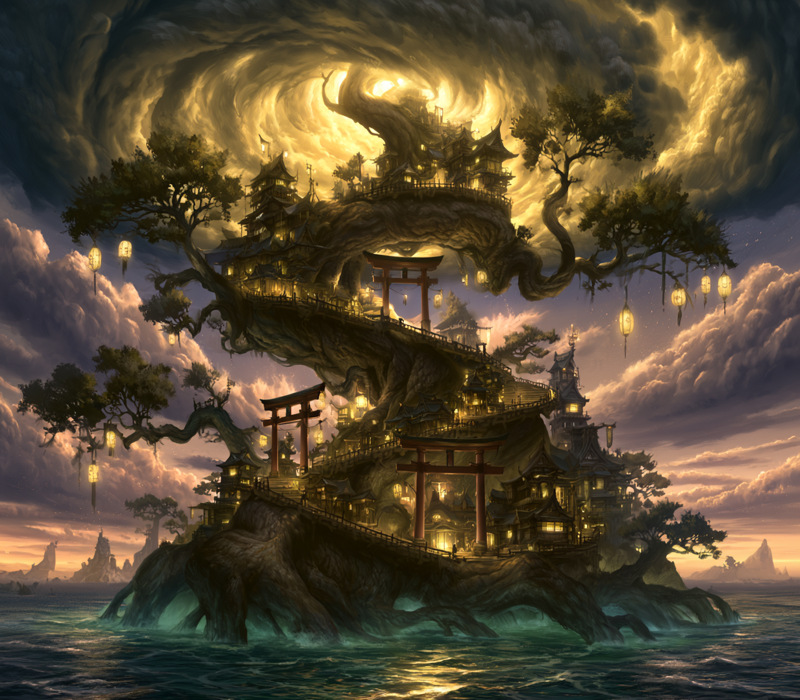

The Ring of Vigil
"The lowest gate receives. The middle gate weighs. The highest gate protects."
—Lady Fa Q, Guardian of Yorishiro
Overview
Above the workshops and rain galleries of the Second Ring, the village narrows.
Broad terraces become measured courtyards. Market noise fades beneath the ringing of bells. The fragrance of cedar and lacquer gives way to white incense, polished bronze, old paper, and the clean scent of rain upon stone.
The Third Ring is the highest inhabited portion of Hanami Village.
It wraps around Yorishiro upon platforms grown from living wood and reinforced with pale stone, bronze supports, and ropes braided from sacred reeds. Narrow bridges cross open spaces between the trunk and its immense branches. Reflecting pools catch broken images of the turning clouds, while gardens of raked white gravel remain undisturbed despite the constant wind.
The First Ring lives by the sea.
The Second Ring lives by craft and contemplation.
The Third Ring lives by authority, ritual, and vigilance.
Here dwell the shrine keepers, storm readers, archivists, teachers, senior wardens, ceremonial officials, and old families whose status comes from generations of service to the village.
At the center of the Ring stands Lady Fa Q, Guardian of Yorishiro, Storm Watcher, and de facto leader of Hanami Village.
First Impressions
Visitors entering the Third Ring immediately notice:
-
the absence of raised voices;
-
bronze bells suspended beneath nearly every roof;
-
white paper streamers tied around the oldest branches;
-
shallow pools reflecting the circling storm;
-
wardens in lacquered masks standing beside quiet stairways;
-
servants and officials moving with deliberate precision;
-
the constant presence of Raiko beyond the branches.
The storm is more visible here than anywhere below.
Its clouds turn beyond the village like an immense wall of bruised silver. Lightning travels silently through their depths before thunder arrives moments later.
The people of the Third Ring do not look away from it.
Watching the storm is considered a duty.
Being watched by the storm is considered inevitable.
The Nature of Authority
The Third Ring does not possess a formal throne room.
It does not require one.
Authority is expressed through ritual, responsibility, and access.
Residents of the First Ring speak for families and neighborhoods. Artisans of the Second Ring earn influence through service and reputation. In the Third Ring, authority belongs to those entrusted with duties that affect the entire village.
These duties include:
-
maintaining the binding rites around Yorishiro;
-
observing Raiko and predicting changes in the storm;
-
preserving village records;
-
settling disputes between the Rings;
-
regulating access to the upper branches;
-
organizing evacuation and relief during disasters;
-
interpreting dangerous spiritual or planar phenomena.
The Third Ring’s inhabitants rarely describe themselves as rulers.
They are caretakers. Administrators. Watchers. Protectors.
The distinction is sincere. It is also politically useful.
Lady Fa Q
Guardian of Yorishiro and Storm Watcher
Lady Fa Q is a female yuan-ti pureblood of poised bearing and flawless composure.
Her formal titles are:
Yorishiro no Ban’nin
Guardian of Yorishiro
Arashimori
Storm Watcher
She serves openly as an emissary of Ashema Deva, the Guiding Light, a divine figure associated with duty, sacrifice, protection, and the ordering of civilization against chaos.
Lady Fa Q never calls herself the ruler of Hanami Village.
She describes herself as the servant of three things:
-
the village;
-
the storm;
-
the Guiding Light.
Her garments are layered silks of ivory, ash-grey, and muted gold. Their embroidery depicts rays of sunlight breaking through storm clouds. Her dark gold eyes are reflective, and her slitted pupils narrow visibly only when she is angered.
Lady Fa Q rarely raises her voice.
She does not need to.
Her questions are precise. Her decisions are measured. Her attention can make even an innocent person reconsider every choice that brought them before her.
The people respect her because her virtues are real.
She ensures that food reaches the First Ring during lean seasons.
She prevents the wealthy artisans of the Second Ring from controlling scarce resources.
She settles disputes with consistency.
She has stood openly upon the Stormwatch Terrace during disasters when others sought shelter.
Many villagers owe their lives to her decisions.
The most common saying about her is simple:
“The Guardian never raises her voice.”
Nobody fears her temper.
They fear disappointing her.
The Guiding Light
Lady Fa Q teaches that civilization survives because some are willing to stand between danger and those unable to face it alone.
The teachings of Ashema Deva emphasize:
-
duty before comfort;
-
protection of the vulnerable;
-
clarity of purpose;
-
obedience to just authority;
-
discipline in times of fear;
-
sacrifice for the survival of the whole.
These principles have genuine appeal in Hanami Village.
The people live beneath a bound magatsuchi, surrounded by a supernatural storm, separated from the ordinary routes of the world. They understand that survival depends upon cooperation and responsibility.
The Hall of the Guiding Light provides food during shortages, shelter during storms, education for promising children, and mediation for disputes.
Its benevolence is visible.
Its doctrine is practical.
Its influence continues to grow.
Behind the Guiding Light
Ashema Deva is not an independent celestial power.
The Guiding Light is one of the Three Faces of Asmodeus.
Almost no one in Hanami Village knows this.
Lady Fa Q does.
She serves willingly.
Within the deeper hierarchy of the Guiding Light, she is known as the Curator.
Lady Fa Q does not consider herself a deceiver. She believes names matter less than results. Ashema Deva’s teachings have preserved order, reduced suffering, and helped keep the village alive.
If revealing the identity of her patron would destroy the system protecting Hanami, then truth becomes another danger to be contained.
The Hall of the Guiding Light
The largest public building in the Third Ring serves simultaneously as temple, court, school, and emergency refuge.
It contains a statue of Ashema Deva. Additionally, a polished bronze disk hangs behind the central dais. It reflects sunlight regardless if the sky is clear or darkened by Raiko.
The Hall is open to residents of all three Rings.
It functions as:
-
a place of worship;
-
a court of arbitration;
-
a school for selected children;
-
a shelter during dangerous storms;
-
a kitchen during food shortages;
-
a place where contracts and public vows are witnessed;
-
a meeting hall for matters affecting the entire village.
Sister Kiyome leads the public rites.
Lady Fa Q presides only during major festivals, crises, and the swearing of especially important oaths.
A person making a vow before the bronze disk is expected to watch their own reflection while speaking.
The custom is said to remind petitioners that every promise is first witnessed by the self.
The Stormwatch Terrace
The Stormwatch Terrace is the highest open platform regularly occupied by villagers.
It projects from Yorishiro’s trunk into empty air, supported by immense branches beneath it. No roof covers the platform. Rain, wind, and lightning are allowed to pass above it without obstruction.
From here, the Eyes Beyond Rain study Raiko.
Their instruments include:
-
bronze wind vanes;
-
rain gauges carved from hollow bamboo;
-
divination mirrors;
-
suspended prayer wheels;
-
spirit lampions;
-
lengths of dyed paper that reveal invisible currents;
-
bowls of seawater that ripple before changes in the storm;
-
bells tuned to different forms of planar disturbance.
The title of Arashimori belongs only to Lady Fa Q.
The Eyes Beyond Rain serve beneath her and maintain constant observation.
Their responsibilities include:
-
predicting dangerous surges;
-
identifying safe sailing windows;
-
maintaining storm wards;
-
recording lightning patterns;
-
ringing the Storm Bells
-
warning the lower Rings of incoming floods;
-
watching for movement within the clouds.
Most villagers believe Raiko merely circles the island.
The Eyes Beyond Rain know that the storm sometimes turns its attention inward.
The Shrine Courts
The Third Ring contains the largest collection of shrines in Hanami Village.
Unlike the intimate sanctuaries of the Second Ring, these shrines are formal places of public ritual. They stand in quiet courtyards separated by painted screens, bell ropes, reflecting pools, and paths of white stone.
Each attends to a particular aspect of village life:
-
safe childbirth;
-
household peace;
-
fishing;
-
fire;
-
storms;
-
climbing;
-
dreams;
-
lost objects;
-
departures;
-
safe returns.
The Shrine Courts are overseen by Miko Tsukina, who maintains the old traditions of the village.
Tsukina teaches that no single spirit, doctrine, or authority can sustain Hanami alone.
This places her in quiet opposition to the growing influence of the Guiding Light.
Their disagreement remains courteous. For now.
The House of the Guardian
Lady Fa Q’s residence is modest compared with the grand homes one might expect of Hanami’s leader.
The building stands against Yorishiro’s trunk behind a courtyard of white gravel and black stones. Its rooms are separated by painted screens depicting sunlight emerging through clouds.
The public chambers contain few possessions.
Visitors are received upon woven mats before a low table. Tea is poured before any matter of importance is discussed.
Lady Fa Q’s private residence extends farther into the trunk than most villagers realize.
Behind sealed screens lie:
-
confidential village records;
-
maps of the upper branches;
-
reports gathered by the Eyes Beyond Rain;
-
objects recovered from planar disturbances;
-
ledgers recording promises, favors, weaknesses, and obligations;
-
a hidden sanctuary dedicated to the true nature of the Guiding Light.
The Guardian’s residence is rarely guarded visibly.
Visitors nevertheless feel watched from the moment they enter the courtyard.
The Upper Archive
The Upper Archive preserves records too important or dangerous for the Bell Archive below.
Its collections include:
-
accounts of the original binding ritual;
-
records of every major change in Raiko;
-
genealogies of the village’s oldest families;
-
maps of paths that no longer exist;
-
reports of creatures emerging from Yorishiro;
-
testimony concerning planar crossings;
-
sealed records of failed expeditions;
-
decrees issued by previous Guardians.
Access requires permission from Lady Fa Q or her First Secretary, Qiao Ren.
Some records are written on paper. Others are carved into wood, etched into bronze, woven into cords, or encoded through patterns of bells.
The archivists teach that no single medium should be trusted with the preservation of truth.
The Ring Wardens
The Ring Wardens maintain order throughout Hanami Village, though their presence is most visible in the Third Ring.
They wear dark robes beneath lacquered armor and carry curved swords, hooked staves, or long spears suited for fighting upon narrow bridges.
Their duties include:
-
guarding restricted paths;
-
escorting official visitors;
-
enforcing Lady Fa Q’s rulings;
-
responding to fires and storm damage;
-
protecting ritual sites;
-
preventing unauthorized entry into the upper tree.
They are commanded by Tobari Shun, nephew of Rojin, Elderman of the First Ring.
Where Rojin trusts custom and community, Shun trusts structure and procedure.
Their disagreements are famous.
Neither discusses them publicly.
Daily Life
Morning begins with bells.
The first bell wakes the Ring.
The second opens the Hall of the Guiding Light.
The third marks the changing of the storm-watch.
Residents sweep the streets before breakfast. Reflecting pools are cleared of leaves. White paper streamers are replaced when damp or torn.
Public business begins after morning tea.
Petitions are heard.
Storm reports are delivered.
Children attend lessons.
Shrine keepers prepare offerings.
Wardens change posts.
The afternoon is quieter. Officials conduct private meetings, archivists work behind closed screens, and the Eyes Beyond Rain maintain their watch.
Evening brings low chanting from the shrines and the slow lighting of bronze lanterns.
After darkness falls, few residents linger outdoors without purpose.
Raiko appears closer at night.
Sometimes lightning reveals shapes moving inside it.
Important Locations
Hall of the Guiding Light
Temple, courthouse, school, and refuge dedicated to Ashema Deva.
Its polished bronze disk reflects every worshiper who kneels before it.
Stormwatch Terrace
Highest regularly occupied platform in Hanami Village.
The Eyes Beyond Rain monitor Raiko from here at all hours.
House of the Guardian
Residence and administrative seat of Lady Fa Q.
Publicly restrained.
Privately extensive.
Shrine Courts
A collection of formal shrines dedicated to the many spirits and concerns of village life.
Their old traditions increasingly compete with the teachings of the Guiding Light.
Upper Archive
Repository of Hanami’s most important and dangerous records.
Entry requires official permission.
The School of the Upper Bough
A small school admitting gifted children from all three Rings.
Its lessons include:
-
history;
-
writing;
-
navigation;
-
ritual etiquette;
-
elemental theory;
-
storm recognition;
-
village law.
Admission is theoretically based on merit.
Several old families would prefer otherwise.
Pavilion of the White Reed
A narrow pavilion behind the Hall of the Guiding Light.
Villagers speak through a paper screen to a masked confessor known only as the White Reed.
Those who enter leave with reassurance, penance, or instruction.
Their secrets do not always leave with them.
House of the Hollow Bell
A sealed bell tower standing near the final ascent.
Its oldest bell is never rung by human hands.
According to Master Isao, it has sounded three times during his lifetime.
Each time, Raiko changed.
Kumogakure-no-Mon
The Gate Hidden in Clouds
At the far edge of the inhabited Ring stands the smallest and highest of Hanami’s three vermilion gates.
Kumogakure-no-Mon marks the boundary between the village and the sacred upper body of Yorishiro.
Beyond it lie:
-
the highest storm-watch stations;
-
old binding shrines;
-
abandoned platforms;
-
sealed paths among the branches;
-
places where Faerie and the Material Plane overlap;
-
regions where Yorishiro’s dreams become dangerously real.
Passage is restricted to:
-
Lady Fa Q;
-
senior members of the Eyes Beyond Rain;
-
designated shrine keepers;
-
wardens carrying the Guardian’s seal;
-
those summoned for a specific rite;
-
individuals granted exceptional passage during a crisis.
Tradition requires Lady Fa Q to be accompanied by one storm reader and one keeper of the old shrines whenever she passes publicly.
The gate is watched by three entities known as the Unblinking Attendants:
-
a stone fox with a cracked jaw;
-
a bronze crane with folded wings;
-
a wooden serpent coiled around the right pillar.
They appear to be statues. They are not.
The Leaving of Burdens
Anyone permitted through Kumogakure-no-Mon must surrender one thing that would interfere with their purpose above.
A weapon.
A title.
An unresolved grievance.
A treasured possession.
A promise to return quickly.
The object is placed within a wooden box and kept beside the gate until the traveler returns.
The rite is not intended as punishment.
It acknowledges that ordinary burdens cannot always be carried into sacred places.
Lady Fa Q publicly leaves behind the golden disk representing Ashema Deva.
Nobody knows what the Curator leaves behind when she crosses the gate in secret.
Customs
Visitors to the Third Ring are expected to:
-
lower their voices;
-
remove footwear before entering official or sacred buildings;
-
carry a visible token of their purpose;
-
wait to be acknowledged before speaking to an official;
-
accept tea before discussing business;
-
avoid touching storm instruments;
-
never interrupt the ringing of a bell;
-
bow toward Kumogakure-no-Mon even if they do not intend to approach it.
Visitors are not expected to understand every custom.
They are expected to observe before acting.
Politics of the Third Ring
Three broad factions influence the Ring.
The Guiding Light
Centered upon Lady Fa Q and the Hall of Ashema Deva.
Its adherents believe survival requires discipline, hierarchy, sacrifice, and unified authority.
They are charitable, organized, and increasingly powerful.
The Shrine Keepers
Led informally by Miko Tsukina.
They believe Hanami survives through balance among many spirits, customs, households, and traditions.
They do not oppose Lady Fa Q openly.
They fear any doctrine that claims to be the only necessary light.
The Old Houses
Families whose ancestors served former Guardians, maintained ancient rites, or helped rebuild the village after past disasters.
They describe themselves as custodians of tradition.
Some are exactly that.
Others are primarily custodians of their own status.
They support Lady Fa Q when her authority protects their position and resent her whenever it does not.
The Lower Rings
The people of the First Ring see the Third as distant but necessary.
The artisans of the Second Ring see it as a patron, regulator, obstacle, and source of prestige.
The Third Ring regards the lower village as something to be:
-
protected;
-
organized;
-
supplied;
-
educated;
-
taxed;
-
occasionally overruled.
Lady Fa Q descends to the First Ring several times each year without ceremony.
She listens to complaints, inspects storm damage, visits the sick, and resolves practical disputes.
Lady Fa Q does not rule only from above. That is one reason her authority remains secure.
Rumors
“The storm does not circle Yorishiro. It circles Lady Fa Q.”
“One of the Unblinking Attendants turned its head last winter. Nobody admits to seeing it.”
“The White Reed knows every secret confessed in the village and has never forgotten a single one.”
“There is a room inside the Upper Archive containing maps of places that have not yet appeared.”
“The forbidden bell sounds whenever something crosses between worlds without permission.”
“Lady Fa Q once stood upon the Stormwatch Terrace for three days without eating or sleeping. When she finally came down, the storm had moved a mile farther from the island.”
“The bronze disk in the Hall sometimes reflects a burning city instead of the person kneeling before it.”
Adventure Opportunities
The Third Ring is a place of access, authority, and concealed agendas.
Here the party may:
-
petition Lady Fa Q for permission to enter restricted areas;
-
seek official aid for the expedition into the derro mines;
-
obtain storm forecasts from the Eyes Beyond Rain;
-
research the binding ritual in the Upper Archive;
-
discover tensions between the Shrine Keepers and the Guiding Light;
-
investigate the White Reed and the secrets gathered through confession;
-
learn that Raiko’s pattern is changing;
-
hear the forbidden bell ring;
-
gain permission to pass through Kumogakure-no-Mon;
-
discover that the benevolent Guiding Light casts a much longer shadow than anyone suspects.
The Third Ring should not feel openly hostile.
Its danger lies in something subtler.
It is orderly.
It is beautiful.
It is safe.
And almost everything within it belongs, in one way or another, to Lady Fa Q.





Your worldbuilding gives hanami village a vivid atmosphere that immediately made me want to learn more about its history and the people who live there. what inspired you to create this village, and is there a particular character or event that you consider the heart of its story?